Forests, Natural Vegetation & Protected Areas of India
TGPRB Constable / SI · Core environmental geography note. Master Champion & Seth vegetation zones, India State of Forest Report (ISFR) statistics, Biosphere Reserves, National Parks, Project Tiger, and Telangana's Kawal & Amrabad sanctuaries.
How TGPRB tests this topic
Master the spatial distributions, characteristic tree species, state forest cover rankings, and environmental movements.
Predicted 2026 Question Patterns
Primary Format: Match the Following (National Park / Biosphere Reserve ↔ State / District, e.g., Keibul Lamjao ↔ Manipur, Dachigam ↔ J&K, Silent Valley ↔ Kerala) and Vegetation ↔ Tree Species (Teak & Sal ↔ Tropical Deciduous; Rosewood & Mahogany ↔ Tropical Evergreen). Watch out for Telangana's Kawal vs Amrabad Tiger Reserves and Largest Area (MP) vs Highest % (Mizoram).
The Visual Architecture
India's vegetation spans six major bioclimatic zones determined by rainfall gradients, temperature, and relief: from the wet evergreen rainforests of the Western Ghats to the alpine meadows of the high Himalayas.
Master Natural Vegetation & Forest Zones Map of India
Champion & Seth classification: Tropical Wet Evergreen, Moist Deciduous, Dry Deciduous, Thorn, and Montane
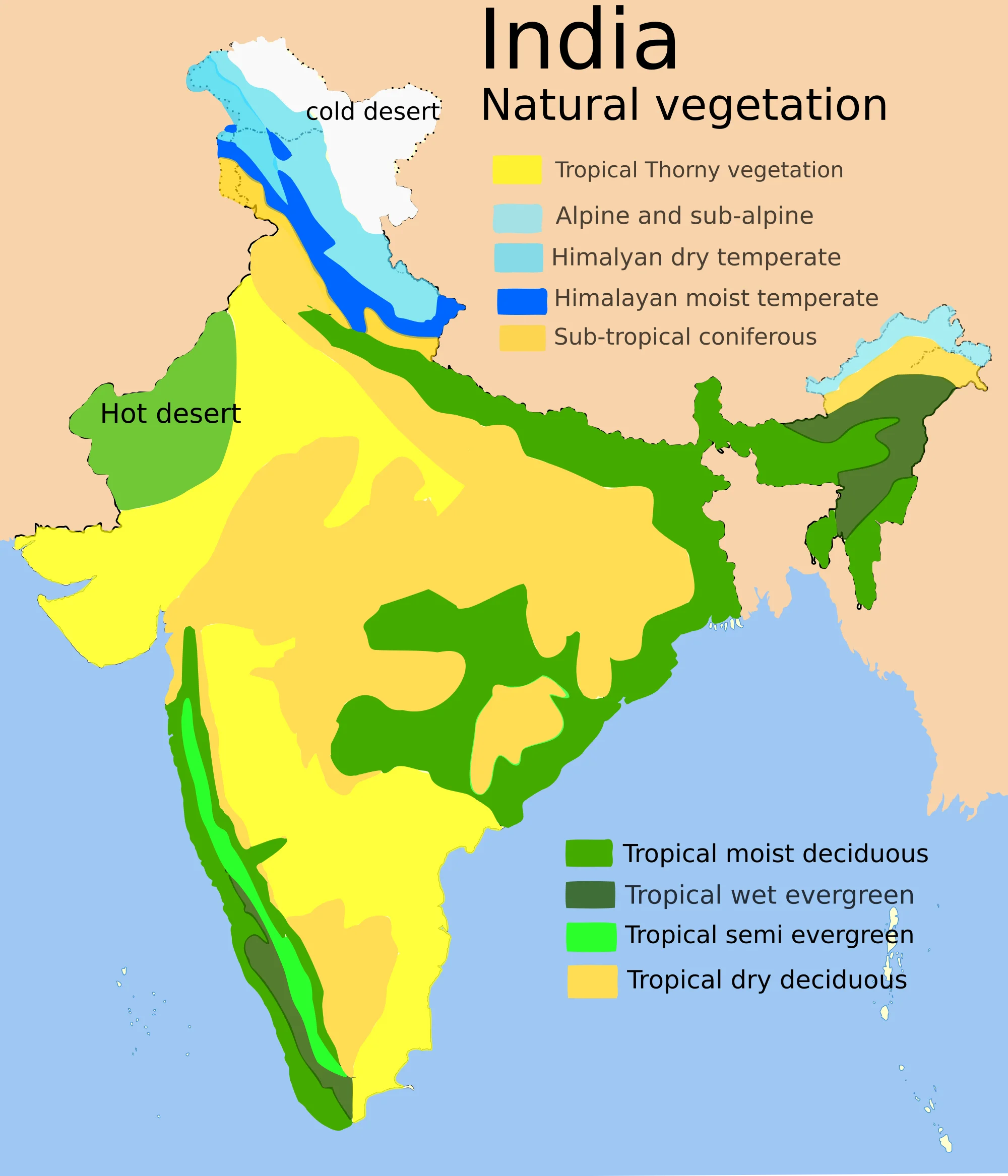
18 Biosphere Reserves of India (UNESCO MAB Network)
18 Reserves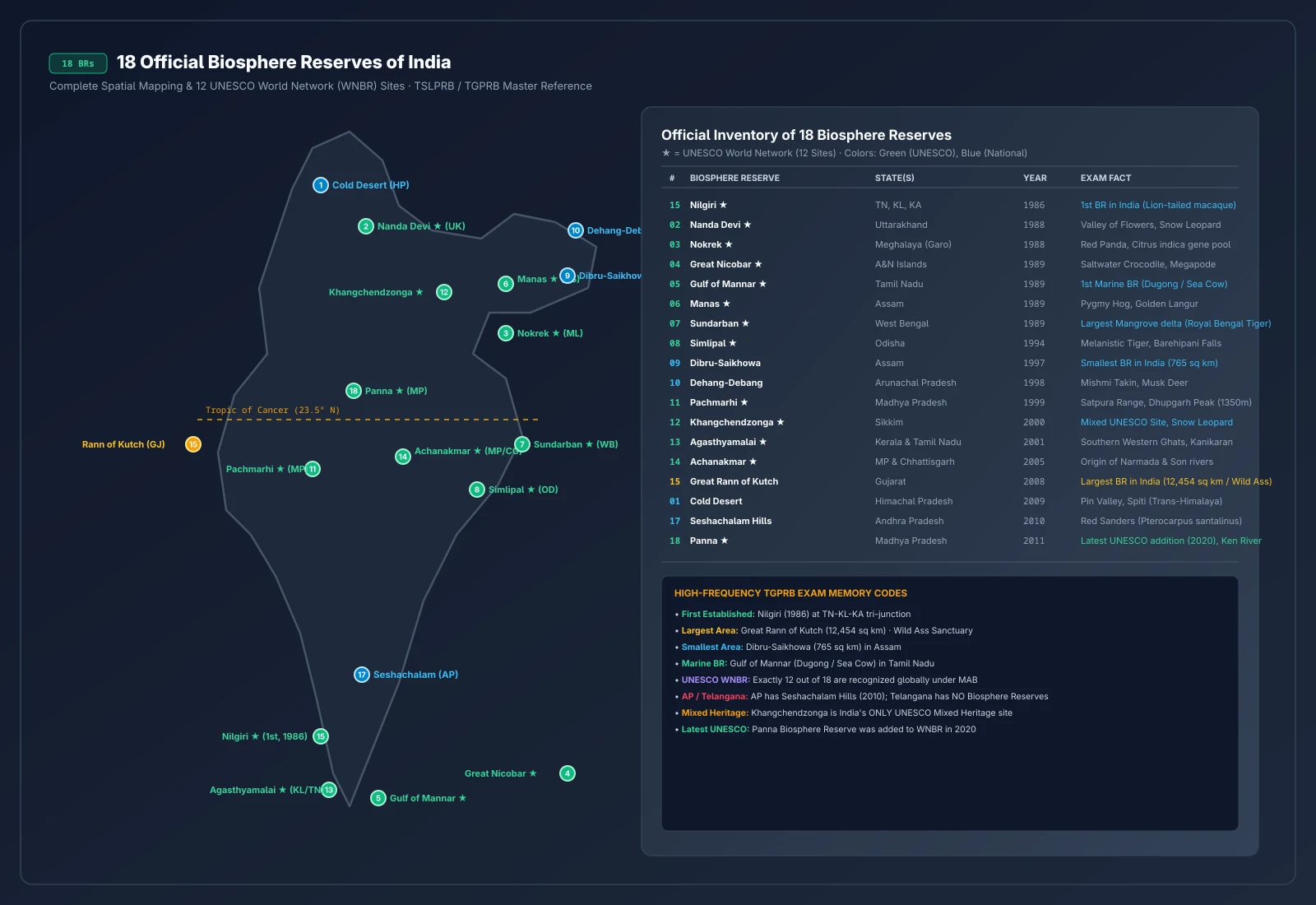
Key Milestones: First: Nilgiri (1986); Largest: Great Rann of Kutch (Gujarat); Smallest: Panna (MP) / Dibru-Saikhowa (Assam); Marine: Gulf of Mannar.
Nilgiri Biosphere Complex (TN - Kerala - Karnataka Tri-Junction)
Tri-Junction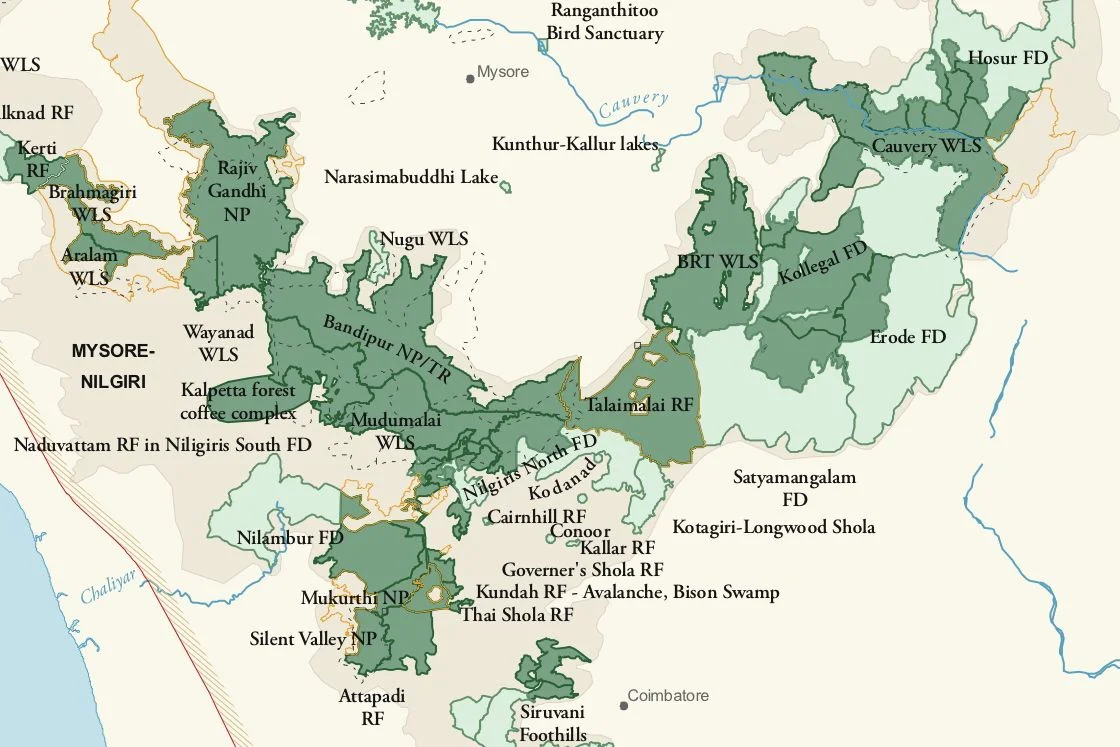
Protected Interlocks: Bandipur & Nagarhole (Karnataka) + Wayanad (Kerala) + Mudumalai & Mukurthi (TN) + Silent Valley (Kerala).
Mangrove Ecosystem Adaptations (Littoral / Swamp Forests)
Pneumatophores (Breathing Roots), Stilt Roots & Vivipary Germination
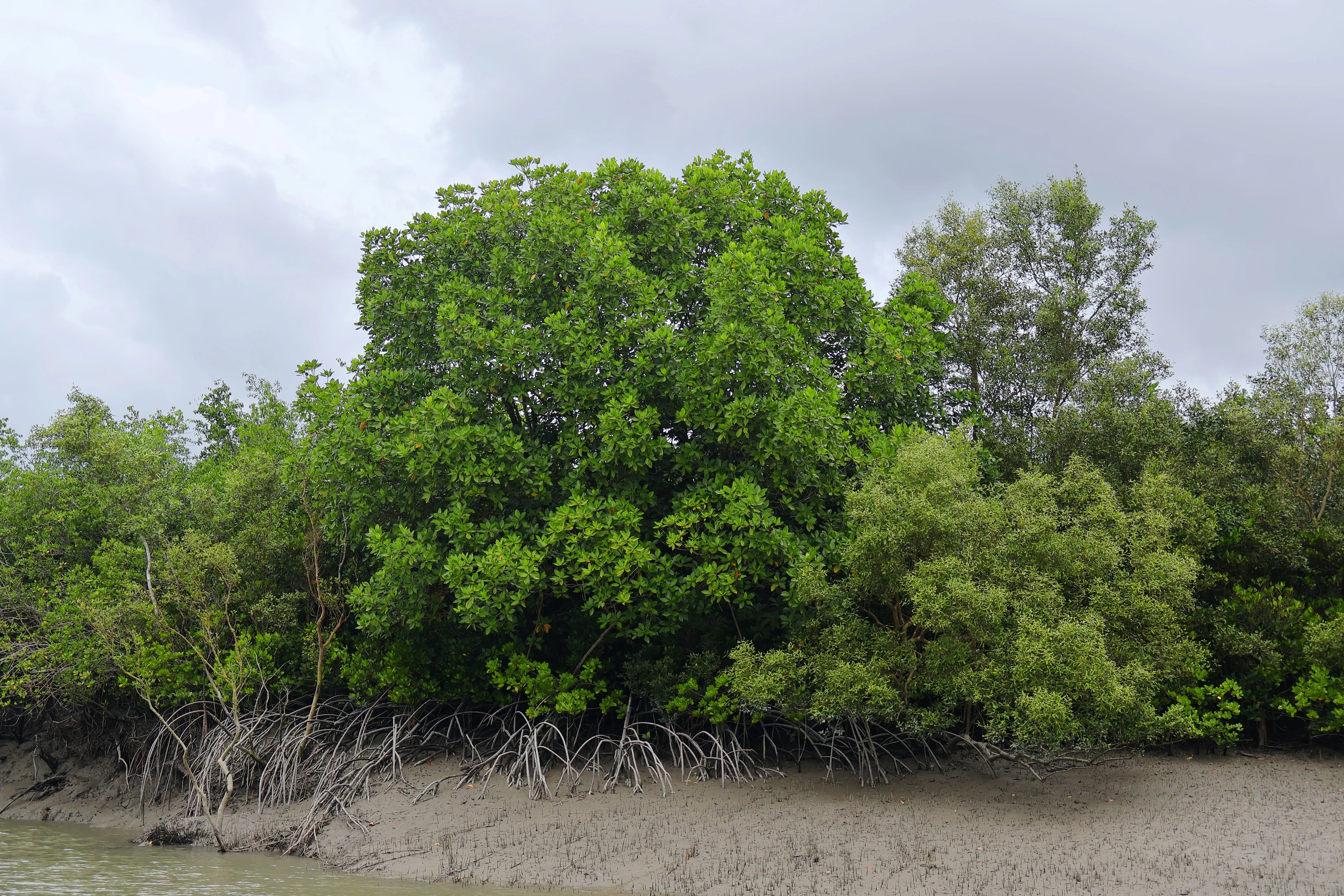
1. Pneumatophores (Blind/Breathing Roots): Upward-growing roots with lenticels (pores) that take in oxygen in waterlogged, anaerobic saline mud.
2. Stilt & Prop Roots: Provide mechanical stability against powerful ocean tides and cyclonic waves.
3. Vivipary Germination: Seeds germinate and develop while still attached to the parent tree before dropping into saline water (e.g., Rhizophora).
4. Core Indian Habitats: Sundarbans (West Bengal - 42.45% of India's mangroves), Gujarat coastline (23.66%), Andaman & Nicobar Islands, Mahanadi delta (Bhitarkanika), Godavari-Krishna deltas (Coringa Sanctuary in AP), and Pichavaram (Tamil Nadu).
Introduction & Forest Policies
In the Constitution of India, 'Forests' and 'Protection of Wild Animals & Birds' were transferred from the State List to the Concurrent List (List III, 7th Schedule) by the 42nd Constitutional Amendment Act, 1976.
Constitutional Mandates
- Article 48A (DPSP): Added by 42nd Amendment 1976. The State shall endeavour to protect and improve the environment and safeguard forests and wildlife.
- Article 51A(g) (Fundamental Duty): Duty of every citizen to protect and improve the natural environment including forests, lakes, rivers, and wildlife.
- Schedule VII (Entry 17A & 17B): 'Forests' and 'Protection of wild animals and birds' in Concurrent List.
Statutory Milestones
- National Forest Policy, 1988: Mandates minimum 33.33% (one-third) of total geographical land area under forest/tree cover (60% in hilly and mountainous regions).
- Wildlife Protection Act, 1972: Created 6 schedules of protection; established National Parks, Wildlife Sanctuaries, Community Reserves, and NTCA.
- Forest (Conservation) Act, 1980 (Amended 2023): Restricts de-reservation of forests or diversion for non-forest purposes without Central approval.
- Forest Rights Act (FRA), 2006: Recognizes pre-existing rights of Scheduled Tribes and Other Traditional Forest Dwellers (OTFD).
Forest Types & Vegetation Deep Dive
Sir H. G. Champion and S. K. Seth (1968) classified India's forest vegetation into 5 major groups and 16 sub-types. The 5 major macro-types are rigorously tested in TGPRB:
Tropical Wet Evergreen & Semi-Evergreen Forests
Spatial Distribution:
Western slopes of Western Ghats (Kerala, Karnataka, Goa, Maharashtra), North-Eastern states (Assam, Meghalaya, Tripura, Mizoram, Nagaland), and Andaman & Nicobar Islands.
Distinct Characteristics:
Dense multi-layered canopy (trees reach 60m+ height). No definite leaf-shedding season. Rich in epiphytes, lianas, and ferns. Semi-evergreen occurs in transitional zones (rainfall 200-250cm).
Indicator Tree Species (PYQ Crucial):
Rosewood, Mahogany, Ebony, Aini, Rubber, Cinchona, Chaplash, White Cedar.
Tropical Moist Deciduous Forests
Spatial Distribution:
Foothills of Himalayas (Siwaliks), Chotanagpur Plateau (Jharkhand, West Bengal, Odisha), Chhattisgarh, eastern slopes of Western Ghats, and north-eastern peninsular highlands.
Distinct Characteristics:
Shed leaves for 6-8 weeks during spring and early dry summer to conserve moisture. Economically the most valuable timber forest type of India.
Indicator Tree Species (PYQ Crucial):
Teak (Tectona grandis), Sal (Shorea robusta), Sandalwood (Santalum album), Shisham, Mahua, Amla, Semul, Kusum, Bamboo.
Tropical Dry Deciduous Forests (Most Widespread in India)
Spatial Distribution:
Rainier parts of Peninsular plateau (Telangana, Andhra Pradesh, Maharashtra, Karnataka), plains of Uttar Pradesh, Madhya Pradesh, and Bihar.
Distinct Characteristics:
Open stretches with patches of grass. Trees shed completely in dry season, leaving the landscape looking bare and leafless. Prone to seasonal forest fires.
Indicator Tree Species (PYQ Crucial):
Tendu (Bidi leaf), Palas (Flame of the forest), Bel, Khair, Axlewood (Dhaora), Amaltas, Teak, Neem.
Tropical Thorn & Scrub Forests
Spatial Distribution:
Semi-arid areas of south-west Punjab, Haryana, Rajasthan, Gujarat, Madhya Pradesh, and rain-shadow interior of Deccan (Rayalaseema / eastern Karnataka).
Distinct Characteristics:
Xerophytic adaptations: Deep long roots to tap groundwater, small fleshy waxy leaves, and sharp thorns/spines to minimize evapotranspiration.
Indicator Tree Species (PYQ Crucial):
Babool (Acacia nilotica), Kikar, Ber (Ziziphus), Khair, Date Palm, Euphorbias, Cacti.
Montane Himalayan & Southern Shola Forests
Himalayan Altitudinal Zonation:
• 1000-2000m: Wet Temperate (Oak, Chestnut)
• 1500-3000m: Temperate Coniferous (Pine, Deodar, Silver Fir, Spruce, Cedar)
• 3000-3600m+: Alpine Forests & Pastures (Silver Fir, Juniper, Birch/Bhojpatra, Rhododendron, Gujjar/Bakarwal grazing lands).
Southern Peninsular Sholas:
Stunted tropical montane evergreen forests found in sheltered valleys (folds) of Nilgiri, Anamalai, and Palani hills above 1500m, interspersed with rolling grasslands. Trees: Magnolia, Laurel, Cinchona, Wattle.
Exam Highlights (PYQ Crucial):
Deodar (Durable timber, Western Himalayas), Birch/Bhojpatra (High altitude line), Shola-Grassland mosaic (Endemic Nilgiri Tahr habitat).
Protected Areas & Telangana Sanctuaries
National Parks, Wildlife Sanctuaries, and Biosphere Reserves form India's core In-Situ conservation architecture under the Wildlife Protection Act, 1972:
| Category | Total in India | Governing Law | Human Activity Permitted? | National Milestones |
|---|---|---|---|---|
| National Parks | 106 | WPA 1972 | Strictly Prohibited (No grazing, no private rights) | First: Hailey / Jim Corbett (1936, UK); Largest: Hemis (Ladakh, 4,400 sq km); Floating: Keibul Lamjao (Manipur). |
| Wildlife Sanctuaries | 573+ | WPA 1972 | Regulated (Grazing and collection of minor forest produce allowed with permit) | Created for particular species (e.g. Gir for Asiatic Lion, Manjira for Marsh Crocodiles). |
| Biosphere Reserves | 18 (12 in UNESCO MAB) | UNESCO MAB | 3-Zone Concept: Core (Strict), Buffer (Research/Education), Transition (Sustainable settlements) | First: Nilgiri (1986); Largest: Great Rann of Kutch (12,454 sq km); Cold Desert (HP). |
| Tiger Reserves | 55 | NTCA (WPA 1972) | Core/Critical Tiger Habitat (Inviolate) + Buffer Zone | 50 Years of Project Tiger (1973-2023). India tiger count: 3,682 (MP: 785, Karnataka: 563). |
Telangana Wildlife Sanctuaries, Tiger Reserves & National Parks
High-yield Telangana GK Matrix (Districts, Fauna, Corridors)
Kawal Tiger Reserve
Mancherial, KB Asifabad, Adilabad, Nirmal
Located on the Godavari-Kadam basin. Forest type: Tropical dry deciduous teak and bamboo. Contiguous to Tadoba-Andhari Tiger Reserve (Maharashtra) via tiger corridor.
Amrabad Tiger Reserve
Nagarkurnool & Nalgonda (Nallamala)
Second largest tiger reserve in India after bifurcation (Nagarjunasagar-Srisailam northern extension). Forest: Dry deciduous scrub and savanna. Home to Chenchu indigenous tribes.
Eturnagaram Sanctuary
Mulugu District
One of the oldest sanctuaries in Telangana (declared 1952 by Hyderabad State). River Dayyum Vagu runs through it. Famous for Sammakka Sarakka Jathara at Medaram.
Pakhal Sanctuary
Warangal / Mahabubabad
Encompasses the historic Pakhal Lake constructed by Kakatiya ruler Ganapati Deva in 1213 AD. Fauna: Leopard, chital, sambar, nilgai, marsh crocodiles.
Shivaram Sanctuary
Mancherial & Peddapalli
Located along the banks of River Godavari. Noted primarily for the conservation of freshwater marsh crocodiles (Muggers) and river otters.
Manjira & Pocharam
Sangareddy & Medak / Kamareddy
Manjira is an aquatic bird and crocodile sanctuary on the Manjira river (9 islands). Pocharam surrounds Pocharam lake (built 1916-1922 across Allair river).
3 National Parks in and around Hyderabad:
India State of Forest Report (ISFR) Statistical Matrix
Forest Survey of India (FSI, Dehradun) Biennial Assessment
1. Madhya Pradesh
77,493 sq km
Followed by Arunachal Pradesh, Chhattisgarh, Odisha, Maharashtra.
1. Mizoram
84.53% of area
Followed by Arunachal Pradesh (79.33%), Meghalaya (76.00%), Manipur.
1. Haryana
3.63% of area
Followed by Punjab (3.67%), Rajasthan (4.87%), and UP (6.15%).
1. West Bengal
42.45% of India total
Followed by Gujarat (23.66%) and Andaman & Nicobar (12.39%).
Source: India State of Forest Report (ISFR 2021), Forest Survey of India (MoEFCC). ISFR 2023/2025 assessment data in release cycle - verify against latest official publication before exam.
Memory Hacks & Negative Marking Traps
TGPRB questions exploit common confusions between forest indicator species, biosphere reserve locations, and state forest percentages:
Trap 1: Sandalwood is Deciduous, NOT Evergreen!
Exam Trap: Examiners often list Sandalwood (Chandan) alongside Rosewood and Mahogany as an option for Tropical Wet Evergreen forest. Sandalwood (Santalum album) is a Tropical Moist Deciduous species endemic to dry/moist deciduous tracts of Karnataka, Tamil Nadu, and Kerala.
Trap 2: Largest Area (MP) vs Highest Percentage (Mizoram)
Exam Trap: 'Largest Forest Cover' without the word 'percentage' means Madhya Pradesh (77,493 sq km). If the question specifies 'Highest percentage of geographical area', the answer is Mizoram (84.53%). Among UTs, Lakshadweep (90.33%) leads.
Trap 3: Chronology of Historic Environmental Movements
Verified PYQs Drill
Solve these 10 verified questions from official TSLPRB Constable and SI papers. Click any card to reveal the official answer and analytical breakdown:
The state having largest area of forest cover in India is
The state with least forested area is
Identify the Tiger Reserve Forests in Telangana State:
The Shivaram Wildlife Sanctuary is located in which of the following districts of Telangana
Match the following List - I: a) Bandipur, b) Corbett, c) Kanha, d) Dhudwa. List - II: i) Uttar Pradesh, ii) Madhya Pradesh, iii) Uttarakhand, iv) Karnataka.
'Hangul' is a critically endangered species found mainly in the State of
'Bison' National park is situated in
Ghughua Fossil Park is located in
Match the following: List-I (a) Narmada bachao andolan (b) Chipko movement (c) Biodiversity concept (d) Vanajeevi List - II (i) Sunderlal Bahuguna (ii) Daripally Ramaiah (iii) Medha Patkar (iv) Edward O Wilson (v) Michael Greenstone Choose the correct answer/pairs :
Read the following statements: A) India's 'Valley of Flowers' is a part of Nanda Devi Biosphere Reserve. B) It is India's second biosphere reserve established in 1986. C) It is located in Tamil Nadu, Kerala and Karnataka. Choose the correct statements
Advanced Practice
TGPSC-Style Advanced Practice
These questions use multi-statement, 4x4 matching, and sequence ranking formats from recent TGPSC Group-I patterns. TGPRB papers (2022-2023) remain 92-93.5% direct factual MCQs. These drills harden your forest area and protected zone recall.
Source: Forensic Paper-Setting Evolution Audit, Aug 2026 - 1,350 questions classified across 7 papers.
Arrange the following States in descending order based on percentage of Geographical Area under Recorded Forest Area (RFA) in 2021 as per the India - State of Forest Report - 2021 published by Forest Survey of India: A. Nagaland B. Sikkim C. Mizoram D. Arunachal Pradesh Choose the correct order:
Match the following National parks and their States: List I (National Park): A. Tadoba National Park B. Madhav National Park C. Dudhwa National Park D. Bandipur National Park List II (State): I. Karnataka II. Uttar Pradesh III. Maharashtra IV. Madhya Pradesh Choose the correct answer:
Match the following Environmental and Forest Acts with their year of enactment: List I (Act): A. Forest (Conservation) Act B. National Green Tribunal (NGT) Act C. Wild Life (Protection) Act D. Biological Diversity Act List II (Year): I. 2010 II. 2002 III. 1972 IV. 1980
Consider the following statements regarding Indian forest types: A. Tropical Wet Evergreen forests occur in regions with annual rainfall exceeding 200 cm and a short dry season. B. Rosewood, Mahogany, Ebony, and Aini are characteristic commercial tree species of Tropical Evergreen forests. C. Tropical Moist Deciduous forests form the most widespread forest cover in India, shedding leaves in dry summer. D. Teak, Sal, Shisham, and Sandalwood are dominant species of Tropical Deciduous forests. Which of the above statements are correct?
Which of the following statements regarding protected areas and wildlife in Telangana are correct? A. Amrabad Tiger Reserve is located in the Nallamala Hills across Nagarkurnool and Nalgonda districts. B. Kawal Tiger Reserve is located in Mancherial, Kumuram Bheem Asifabad, and Nirmal districts in northern Telangana. C. Pakhal Wildlife Sanctuary is located around the historical Pakhal Lake in Jayashankar Bhupalpally / Warangal. D. Telangana has no national parks or tiger reserves notified under the Wildlife Protection Act, 1972. Choose the correct answer:
Comprehension Gate
Current Affairs
Current Affairs (1/136)
Union Environment Minister releases two male Great Indian Bustards into the wild at Desert National Park, Jaisalmer
Two male Great Indian Bustards were released into the wild at Sam in the Desert National Park, Jaisalmer, Rajasthan by Union Minister Shri Bhupender Yadav.
Union Minister for Environment, Forest and Climate Change Shri Bhupender Yadav released two male critically endangered Great Indian Bustards (GIBs) into the wild at the Desert National Park in Jaisalmer, Rajasthan. The Bustard Recovery Programme is a collaborative initiative involving the Ministry, Rajasthan Forest Department, and the Wildlife Institute of India.